Staying Put Is Not Standing Still
October 6, 2026
The headlines say: CMS finalized a 2.48% payment increase for 2027 (CMS press release).
Here's what I'd focus on: I read the files. The plans still changed, and the biggest changes landed on the members nobody is writing about, the ones whose plan simply renews.
Every member gets a letter this fall. The Annual Notice of Change (ANOC) is the letter a plan sends with next year's changes. Three groups already have a story: Service Area Reduction, Clean Carrier Crossover and Split Carrier Crossover. The largest group has no headline, because on paper nothing happened to them. Their plan comes back for 2027 with the same ID. They are staying put.
Staying put is not standing still.
The biggest group, and the quietest letter
Here is the vocabulary, once, in plain words.
- Service Area Reduction: the plan ends or leaves the member's county, per the CMS crosswalk. The member must choose a new plan. (The crosswalk is the file CMS publishes each fall that says where each plan's members go.)
- Carrier Crossover: the carrier moves the member to a different plan they did not choose. A Split Carrier Crossover is when CMS names more than one destination. A Clean Carrier Crossover is when it names one.
- Standard Renewal, Concerning: the same plan ID renews, and a filed change crosses the line where members feel it: premium up $20 a month or more, out-of-pocket maximum up $1,000 or more, or Part D deductible up $200 or more. A card that is gone or cut by half or more, or a Part B giveback that is gone, lands here too, whatever else changes.
- Standard Renewal, Notable Changes: the same plan ID renews with a filed change below that line: a smaller premium, out-of-pocket maximum or deductible rise, a card cut by 10% or more, or supplemental benefits down 10% or more net of anything that went up. The notice of change will say so. The changes are not major, but they are noticeable.
- Annual Review: no flagged change in price, deductible or supplemental benefits for the year being bought. Every member deserves an annual review, and these are the people nobody calls. They may well be fine with their plan. A review is how you find out.
Where every member stands for 2027
| Group | Members |
|---|---|
| Service Area Reduction | 3,153,512 |
| Clean Carrier Crossover | 1,617,829 |
| Split Carrier Crossover | 1,576,697 |
| Standard Renewal, Concerning | 10,744,793 |
| Standard Renewal, Notable Changes | 8,970,924 |
| Annual Review | 3,798,628 |
| Total membership | 29,862,383 |
Of the 23.5 million members who keep their plan ID, about 10.7 million land in Concerning. That is 45.7%. Another 9.0 million renew with changes that are smaller but noticeable. Only 3.8 million get a clean Annual Review.
Concerning is about 3.4 times the size of Service Area Reduction, the group that gets most of the attention.
Here is what moved. The categories now count supplemental benefits as well as price, so a card that is gone or cut by half or more puts a member in Concerning. Annual Review is smaller than the price-only count, because benefit cuts now count.
Key Abrasion Indicators
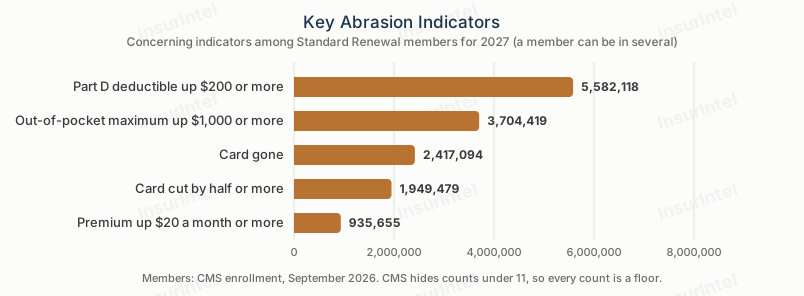
These are the Concerning indicators. A member can cross more than one line, so the five bars overlap. Notable uses lower lines: premium up $10 to $19.99, out-of-pocket maximum up $500 to $999, Part D deductible up $100 to $199, or a card cut by 10% or more.
Standard Renewal Distribution by State
Standard renewals and Concerning members, top eight states by Concerning members
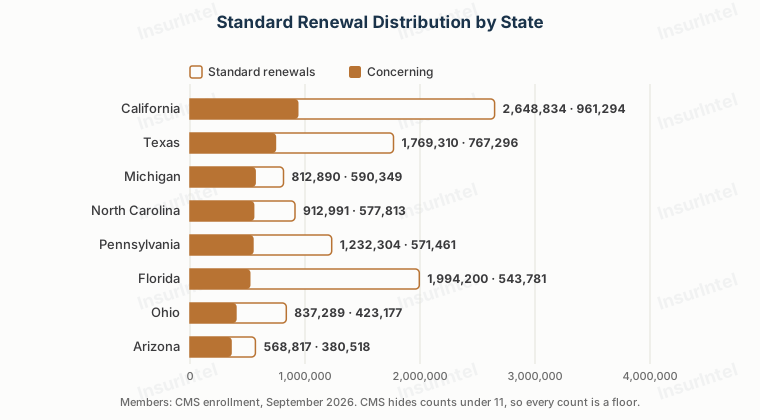
Standard Renewals by State
| State | Standard renewals | Concerning | Share |
|---|---|---|---|
| California | 2,648,834 | 961,294 | 36.3% |
| Texas | 1,769,310 | 767,296 | 43.4% |
| Michigan | 812,890 | 590,349 | 72.6% |
| North Carolina | 912,991 | 577,813 | 63.3% |
| Pennsylvania | 1,232,304 | 571,461 | 46.4% |
| Florida | 1,994,200 | 543,781 | 27.3% |
| Ohio | 837,289 | 423,177 | 50.5% |
| Arizona | 568,817 | 380,518 | 66.9% |
California has the most Concerning members. Among these eight, Michigan has the highest share: nearly 3 in 4 of its renewing members face a change they will feel.
The quiet cost
These members are not in a Service Area Reduction. Nobody tells them to shop. They are the people you assume are fine. Annual Review members have no flagged change in price, deductible or supplemental benefits, so many may well be fine. A review is how you find out.
When the letter lands, a member with a bigger bill and no call from you will call somebody. Make yours the first call.
The Abrasion Report sorts your whole book this way, worst first. See how it works. The this week's free report shows the same view for any county.
Identify Which Plans and Total Membership
Enter your InsurIntel portal to review your renewal membership totals.
Guests can receive the current Spotlight report for county-level insights.
Members only
Larger companies have analytics teams that sort their members before AEP. Most agents do not. I built InsurIntel to bring that analysis to every agent, so you can spend AEP on the conversation.
I spent years studying what keeps an agent's book intact. This is where I'd start.
InsurIntel
I built InsurIntel as a research tool for licensed agents to prepare for appointments. It never recommends enrolling anyone, and commission never ranks a plan. Best, Better and Good are InsurIntel's research recommendations: where I'd start looking, not enrollment advice. It flags the plans whose members face the biggest changes, lines up the plans in the county to research beside them, and saves your notes so every appointment starts prepared. Agency leaders can save their notes once and share them across every agency portfolio.
CMS does not report plan enrollment under 11 members in a county, so every count is a floor.
For licensed agents, not for Medicare beneficiaries.